What Held It Up
Despite what this photo looks like, physics isn’t what was holding that container up. I was.
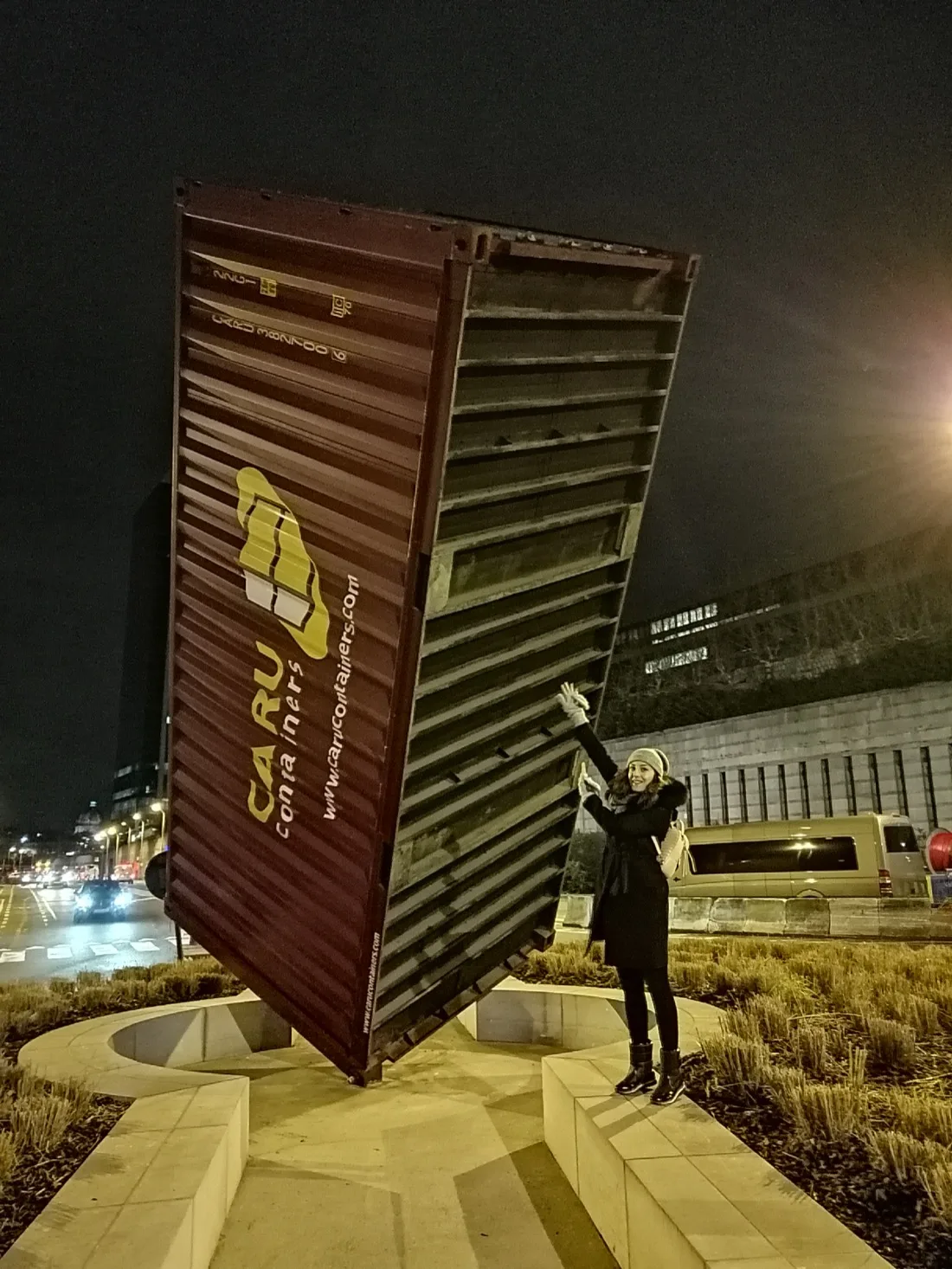
Despite what this photo looks like, physics isn’t what was holding that container up. I was.
The real story
The piece sits in the middle of a roundabout in Brussels — Luc Deleu’s The Container, balanced on one corner. Everyone assumes it’s physics: the right center of gravity, the right angle, a structure holding itself up. But in the photo, my hand is on it. And that’s the real story: getting underneath something and carrying the full weight of it, so it stays standing.
What I saw in logistics
Five years before Syntask, that’s exactly what I saw in logistics. What kept operations standing wasn’t the process, wasn’t the system — it was one operator staying up at night, one manager who never turned their phone off. Everything was balanced on someone’s strength.
Proof, not a pilot
Put this to work on your own operational data.
No integration project. No black box.
Start a 90-Day Proof of ValueWhy I built Syntask
That’s why I built Syntask. To take that balance — held up by one person’s effort — and hand it to a system instead. No one has to stay up at night anymore making sure the container doesn’t tip. Syntask sees it six hours before it starts to fall, tells you why, and tells you what to do.
A founding story
When I put my hand under that container that day, I didn’t know it would become a founding story. But looking back now, I can see it clearly: Syntask exists so that no one has to do alone what I did that day.
Holding something up is, most of the time, an invisible kind of strength.
— Field Note, Brussels 2019
Berna Bulgurcu — Co-founder & CEO, Syntask
Put this to work on your own operational data.
Start with one lane, one workflow, one decision. Measure impact. Expand when value is proven.
No integration project. No black box.
Written by
Berna Bulgurcu
Co-founder & CEO, Syntask
The Syntask team writes about operational decision intelligence for logistics — turning the data teams already have into prioritized, evidence-backed decisions.